

Land Back: A Q&A with Four Indigenous Leaders on the Movement for Sovereignty and Return
Following a long history of Indigenous resistance to stolen land, what began as a meme has become a rallying cry.
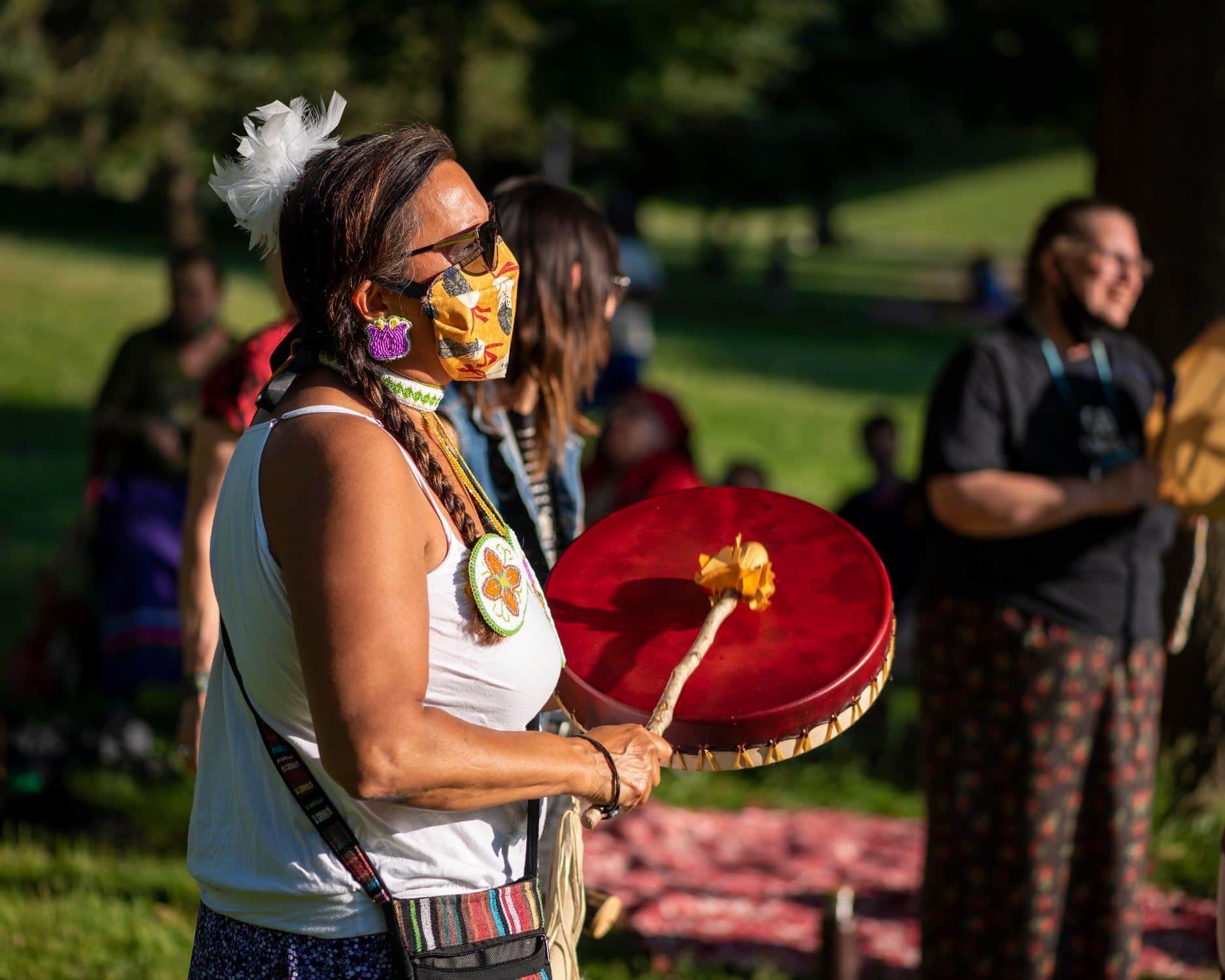
Indigenous community members take part in a drum circle at the Land Back camp in Victoria Park, Kitchener, on the traditional territory of the Haudenosaunee, Anishinaabe and Chonnonton peoples. (O:se Kenhionhata:tie/Facebook)
What began as a meme has become a rallying cry. Following a long history of Indigenous resistance against stolen land, demonstrations, protests and occupations across the country – amid international calls for racial equality – have emerged under the banner of “Land Back.”
From the CN rail blockade erected by the Mohawk Nation in early 2020 to protests of the Coastal GasLink pipeline on Wet’suwet’en territory, the Land Back movement has lifted land claim disputes and First Nations rights to greater prominence. Even in the case of local Indigenous activists, forcing movement by officials.
Months after a group of Indigenous members of the Kitchener and Waterloo communities began a Land Back occupation in Victoria Park, one of the oldest parks in Kitchener, Ontario, Canada, they gained the attention of regional councillors, the Grand River Conservation Authority, and the public at large.
The cities of Kitchener, Waterloo, and Cambridge, along with the Grand River Conservation Authority, concluded a series of meetings that summer that discussed an action plan for reconciliation with Indigenous communities.
The plan involved appointing a consultant or a team of consultants to help address the needs of Indigenous peoples. But just five years earlier, the Truth and Reconciliation Commission of Canada (TRC) had already released a comprehensive report outlining 94 calls to action aimed at exactly that. Among them was a call to reject the old but still persistent ideas used to justify taking Indigenous lands and asserting power over Indigenous communities.
Since the TRC released its report in 2015, several legal actions denying Indigenous peoples the right to protest development on their territories have been served to activists who stood in the way of the private companies seeking to displace communities or claim ownership of properties purchased out from underneath Indigenous land owners.
“80% of injunctions filed against First Nations by corporations were granted,” found a report released by the Yellowhead Institute, which reviewed over 100 injunction cases involving First Nations communities. While “81% of injunctions filed against corporations by First Nations were denied.”

What do you do when the laws that now govern your community, laws imposed long after your people had already established their own systems of law and sovereignty, prevent your rightful access to the lands your people have lived on since time immemorial?
For First Nations communities across Canada, including in Ontario and British Columbia, you demand to be heard.
To help share insights directly from Indigenous communities, I spoke with several Indigenous leaders about the impact of land dispossession, their perspectives on the Land Back movement, and what meaningful reconciliation looks like. These leaders include: Amy Smoke, co-organizer of the Kitchener-Waterloo Land Back movement; Dr. Eva Jewell, Assistant Professor at Toronto Metropolitan University (formerly Ryerson University) and Director of Research at the Yellowhead Institute; Jean Becker, Senior Director of Indigenous Initiatives at the University of Waterloo; and Tammy Webster, teacher and Board President of Anishnabeg Outreach, a nonprofit community hub in Kitchener, Ontario that offers supportive services to First Nations, Inuit, and Métis (FNIM) communities.
What does “Land Back” mean to you?
Amy Smoke: It’s not just about land. It’s about getting culture back, language back, ceremony back, water back. We have lost so much — the erasure of Indigenous knowledge, including Indigenous Two-Spirit knowledge. Land Back is about reclaiming and revitalizing all of it.
Speaking about the Land Back protest in Victoria Park, Kitchener, Ontario, Canada: I would love to see this land returned to Six Nations (the six Haudenosaunee nations whose territory stretches along the Grand River: Mohawk, Onondaga, Oneida, Cayuga, Seneca, and Tuscarora).
This isn’t a land claim.
Dr. Eva Jewell: Throughout Canada’s 152 years as a country, and even before then, since colonialism started, newcomers have landed in what we know as North America today and Turtle Island. There has been a disagreement and a discrepancy about how land should be shared.
So, land back means reckoning with the flawed ways the agreements were carried out and privileging the Indigenous worldview that was present at the time those agreements were being made.
Jean Becker: I think it means different things to different people. It can mean land claims, such as governance agreements, or a literal wanting of the land back, from portions of it to the entire country. I think that when traditional people talk about land, they often talk about stewardship and the protection of the land. It depends on the context.
Tammy Webster: When I hear that hashtag, “land back” implies a sense of ownership and that’s not Indigenous, that’s not First Nations. Land back isn’t about giving land back because that means someone has to own it. And to me, that’s counterintuitive to my upbringing of “we use the land. It was never ours to own.” What I’m trying to do, generally, isn’t necessarily land back or reclaim it.
Before treaties, contact, politics, colonies, and governments came in, we had our own systems, understandings, ways of doing things, and interactions. Let’s reawaken that. Because that’s ‘Indigenous.’
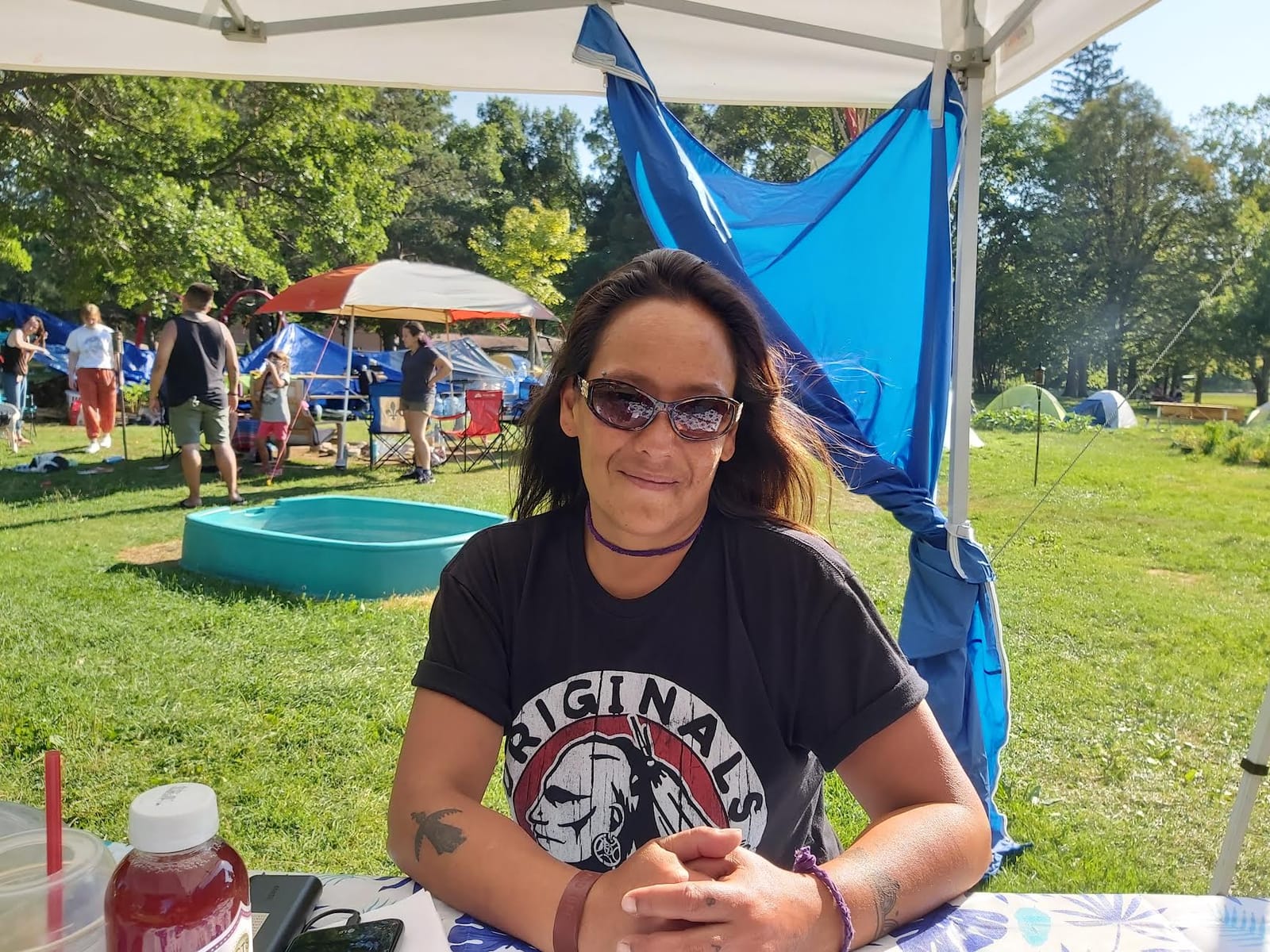
Amy Smoke, co-organizer of the Kitchener-Waterloo Land Back movement, sits under a canopy at the 2020 Land Back camp in Victoria Park, Kitchener. The occupation called for Indigenous land reclamation and raised awareness about ongoing colonial displacement. Photo: Shantal Otchere.
What should people know about Land Back movements?
AS: Most settlers think that we’re asking for it all back, that everybody needs to go home to their countries of origin. That’s not necessarily true. We are looking for sovereignty, the ability to govern ourselves, the autonomy to create our own structures, and take care of the land the way we once did.
The effects of colonization, the intergenerational trauma that comes with all of that, are still very much prevalent today, along with gendered violence. Violence on the land is violence against Indigenous women, Two-spirit women, youth, and femmes as well. They go hand in hand; all of the things that we’re doing to Mother Earth, our original mother, play out in horrific scenarios of colonial violence against Indigenous women as well.
Land Back is the ability to do what we need to continue to heal our communities and heal not only our elders but also our youth and the coming youth.
“It’s always interesting how it’s okay that Indigenous people endure that violence. But settlers are protected from the violence of upheaval on their lands.”
Dr EJ: There’s not really a critical understanding of how stark the dispossession of land is. Or just how stark it is that Canada stole land. I don’t think that the legitimacy of Canada is ever questioned. When I teach, one of the first things I do with students is call into question the formation of the state, the language of the state, the definitions of what a state means versus what a people is.
Those things are never questioned. It’s just accepted that Canada is a legitimate country with jurisdiction over all of these lands, even in places where that jurisdiction is deeply disputed. We saw in the Tsilhqot’in case a few years ago, where the Supreme Court ruled that the entire city of Vancouver is sitting on land that’s not even Canada, that even the Supreme Court is finding the title to this land is actually pretty shaky. People don’t understand that many of the territories that Canada occupied were never actually given up. They just take for fact that Canada is legitimate.
“There’s not really a critical understanding of how stark the dispossession of land is. Or just how stark it is that Canada stole land. I don’t think that the legitimacy of Canada is ever questioned.”
JB: If people read the Yellowhead Institute’s Land Back report, I think they will come to a much better understanding about land. What that report so clearly shows is the extent to which Indigenous people are still being dispossessed of their lands by corporations, by governments, by courts. We’re not just talking about the early colonial days; we’re talking about what’s still going on today.
What does the history of Indigenous land dispossession look like locally?
AS: We chose Victoria Park [in Kitchener, Ontario] because it was a historical trade, feasting, and ceremony site. We’re sort of taking that back.
In an urban setting like this, there are so many Indigenous folks who need space. We need land for ceremony, water, and fire. We need all of those things to be truly who we are, to be peaceful, balanced, sane, and healthy. You don’t often see [Indigenous] people taking up their space and burning a sacred fire.
Dr EJ: In dense metropolitan areas in Canada, such as Vancouver and Vancouver Island, where there’s a lot of private ownership of land, it makes reclaiming land much more difficult. What that specifically means in the Southern Ontario region, for example, is that there was a Supreme Court decision that dealt with the Chippewas of Sarnia, who had said, “There was a land that was dispossessed from us. It was stolen from us. We want it back.” And Canada said, “Sorry, there are settlers on it already.” There are Canadian citizens living on it, and we’re not going to dispossess them of the land for something that we did wrong.
It’s always interesting how it’s okay that Indigenous people endure that violence. But settlers are protected from the violence of upheaval on their lands.
JB: Everything goes back to finding out what has happened and what is happening and understanding that injustices and inequities exist, including in our local region.
You have to look at the statistics, too, to see how it impacts Indigenous people. When Canadians look at the statistics, they may interpret them as suggesting that we’re less than or insufficient. We’re not as smart. We’re not as educated or not as something. However, what they don’t see is that the statistics reflect the impact of colonization.
Continue reading this interview in Part Two.
These interviews have been edited and shortened for clarity. A version of this piece was previously published online.