

Land Back: A Q&A with Four Indigenous Leaders on the Movement for Sovereignty and Return — Part Two
Exploring the lasting impacts of colonial violence and land dispossession on Indigenous communities.
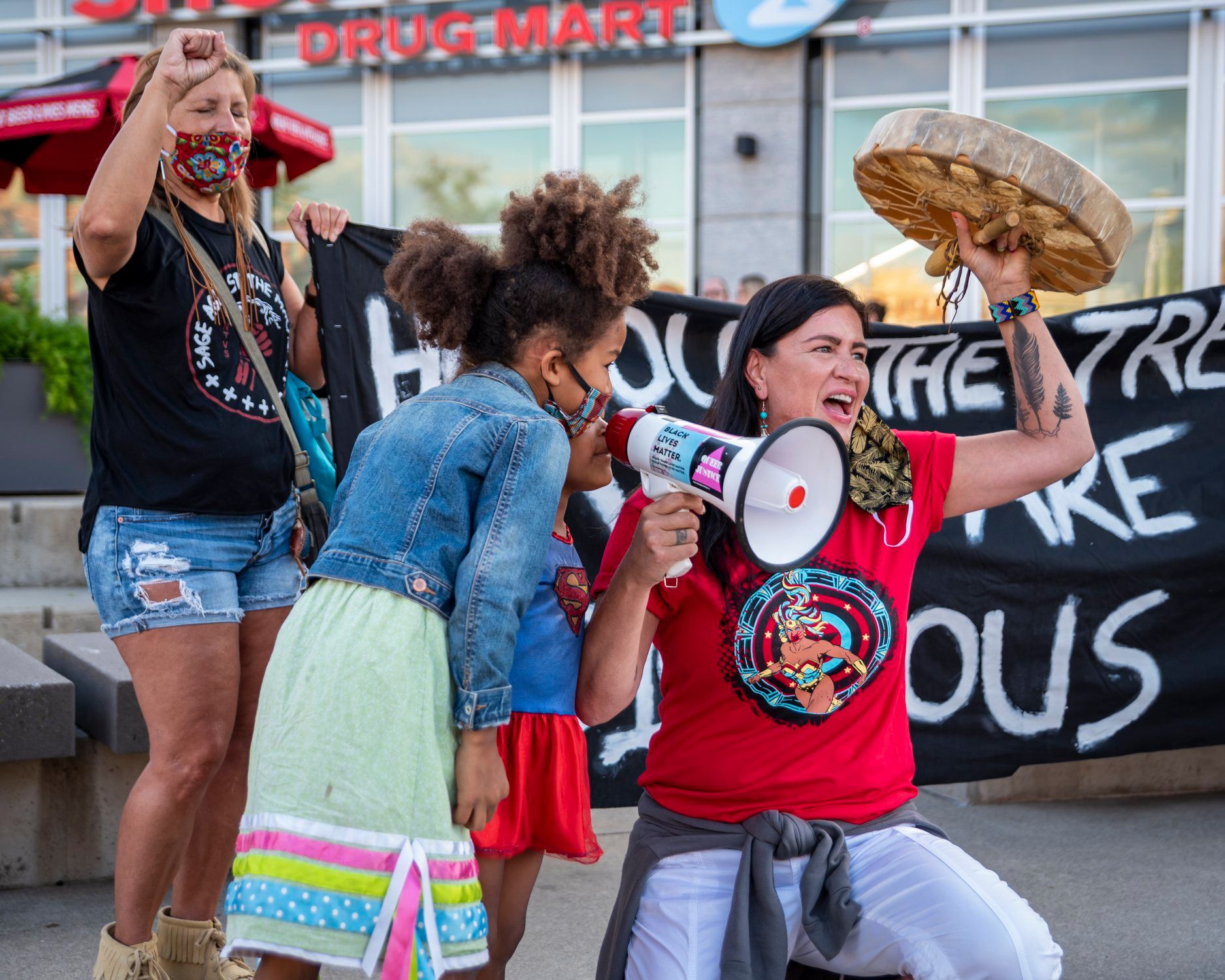
Community members gather with the O:se Kenhionhata:tie: Land Back Camp in Waterloo Square, Ontario, during a demonstration in August 2020 (O:se Kenhionhata:tie/Facebook)
What has been the impact of colonial violence and land dispossession on Indigenous non-men, in particular?
Amy Smoke: The erasure of Two-Spirit and queer people. Missionizing. The conversion of our folks to Catholicism and Christianity — those things have erased us. We went into the closet, but I always joke: there are no closets in tipis or longhouses. There’s nothing for us to come out of. In Kitchener, in particular, I don’t have a Two-Spirit elder that I come to.
I don’t have a song. I don’t have a big drum. Historically, men sit around the big drum in most communities, though that’s not always the case. Firekeeping is also a very gendered role. When men went off and hunted for six months, there’s no way women didn’t start a fire. There’s no way I wore a skirt 24 hours a day in the bush, hunting and fishing. All of those things that are imposed upon us now are troubling.
Colonialism doesn’t like women as leaders. In my nation, it’s matrilineal. The women do the talking, the women are the leaders. We pass on our clans.
Dr. Eva Jewell: One of the core tenets of colonialism is patriarchy. We have, in addition to the element of a centring of men, a centring of heterosexual men and a centring of adults as the dominant authority. That is a tiny part of the population that controls and has power over everybody else.
What would reconciliation look like to you?
AS: Give back all the land — a hundred percent of the land — not just symbolically. No more plaques, no more land acknowledgements without action. They’re just performative; it’s just a recitation.
There isn’t a whole lot that Indigenous people have to reconcile. We know what happened, we know what went wrong. Settlers, Canadians, white Canadians, need to reconcile their past, their history, their part in what went wrong, and all of the things that continue to go wrong in present-day, contemporary Indigenous communities.
Dr EJ: As much as we want to vote for parties that promise all the restitution and reconciliation with Indigenous people, when it really comes down to business and its actions, we see that it’s still reifying the settler state. Justin Trudeau promises reconciliation with Indigenous peoples, but still forces pipelines through territories that have never been ceded. There’s the political system.
It would be a matter of demanding yes, reconciliation with Indigenous peoples, but also recognizing that justice isn’t going to be served until Indigenous people have access to our land.
“When Canadians look at the statistics, they may interpret them as suggesting that we’re less than or insufficient. We’re not as smart. We’re not as educated or not as something. What they don’t see is that the statistics reflect the impact of colonization.”
Jean Becker: Something that I heard Murray Sinclair talk about in one of his many talks stayed with me.
Murray Sinclair, an Ojibwe judge and prominent Indigenous leader in Canada, served as Chief Commissioner of the Truth and Reconciliation Commission. He was also Manitoba’s first — and Canada’s second — Indigenous judge.
He said that first, the truth has to be told. It has to be told, and it has to be listened to, and we’re nowhere near that happening. Until we really have a majority of Canadians who have been educated and understand what happened in this country and what is happening today. Until that groundswell of understanding happens, I don’t know that reconciliation can happen.
Tammy Webster: Reconciliation to me is very levelled, multi-tiered, and woven with so many other things. Reconciliation is my son and my grandchildren being able to identify publicly as First Nations, to be viewed as potential leaders, and to be given value and worth the same as anyone else. So, that involves a lot of healing, and not just for First Nations people; it involves healing for non-First Nations people.
The fact that microaggressions still exist means that reconciliation hasn’t happened. Reconciliation for me is all that anti-oppressive, equity work we’re trying to do because we need to be able to work respectfully in each other’s settings. And that doesn’t happen.
What can non-Indigenous people do to help achieve reconciliation?
AS: Everybody knows about our traumas. We have to relive those traumas every day. The Indian Act, residential school settlements, and the ’60s scoop settlements – we have to prove over and over again the trauma inflicted on us. We have nothing to reconcile. It’s white, settler Canadians who have a lot of work to do.
Dr EJ: Supporting land back and engaging in environmental responsibility.
In the case where settlers are in ownership of our land, being environmentally responsible is kind of like a means to an end. I’m somebody who believes that Indigenous peoples should be in possession of our land and we should have jurisdiction over our land and our treaty territories.
JB: Find out more about the treaty relationships and the territory that they’re on. If there are treaties, awesome. And if there are no treaties, that means that the lands have not been ceded. The lands still do not legally belong to the settlers on them, not even under Canadian law.
Learn more about the Indigenous lands you live on. Find out whether treaties exist and which Indigenous nations have long-standing ties to the territory you now call home by visiting the Native Land Digital website at native-land.ca.
TW: Coming together as a community, building together. We had a couple of mayors here with us [at Anishnabeg Outreach]. We had regional counsellors and the Chief of Police. We had Indigenous staff and non-Indigenous staff. We had some families come, and community members come, and we all came together to do something for the greater good. That’s what reconciliation is about.
Community leaders in the non-Indigenous world are getting hit hard, too. And whether it’s deserved or not, it’s not up to me to decide, but I see them hurting. How do you do this work when people are hurting? You don’t. You continue to hurt each other.
“Decolonization is not a metaphor. The idea that we can decolonize Canada – Canada would cease to exist because you can’t decolonize something that’s inherently colonial. You can’t decolonize politics or decolonize your vote.”
What can the people reading this do to help support Land Back movements?
AS: Allow Indigenous folks the land, access to land, and start paying tribute to Six Nations (the six Haudenosaunee nations located along the banks of the Grand River. These nations include the Mohawk, Onondaga, Oneida, Cayuga, Seneca, and Tuscarora.) The things the government is doing that they say will bring economic prosperity are not for us. We don’t get those jobs. Stop pipelines. All of the things that Indigenous knowledge comes with, in ways of being and doing on land, should be honoured and recognized.
It’s not about “Indigenizing,” more about decolonizing, but really about disrupting. None of these systems and structures currently in so-called Canada are ours. Dismantle them so we can rebuild ours again.
Dr EJ: Inform yourself and understand that it’s an active, everyday thing. And it’s holding your own government accountable, too.
Decolonization is not a metaphor. The idea that we can decolonize Canada – Canada would cease to exist because you can’t decolonize something that’s inherently colonial. You can’t decolonize politics or decolonize your vote. For there to be true restitution, land has to come back to Indigenous people.
JB: In my view, Canadians generally are ill-informed and have been poorly educated in Canadian history. What I think they could do is educate themselves to better understand what is actually happening in these instances. To me, land back is a confrontation with our history of dispossession and colonization. It’s about healing. It’s actually about the human relationship to the earth.
People need to help themselves rather than think that Indigenous people need their help. They need to understand some of the issues and educate others around them. Talking about these things can have a profound impact on their families and friends.
These interviews have been edited and condensed for clarity. A version of this piece was previously published online.