
Letter From Our Founder: Reconnecting in a World Built to Divide Us
The world feels more chaotic. This social disconnection isn’t accidental. It’s a feature of a system that thrives on division.
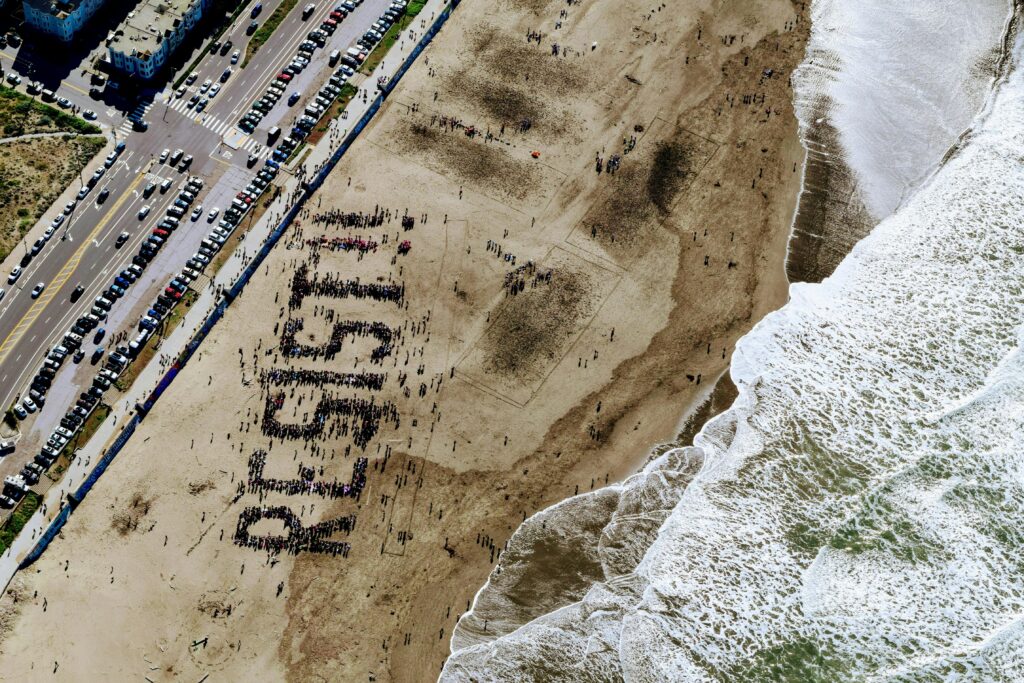
Aerial view of a beach with the word “RESIST” formed by people. Image: Tim Gouw.
In Canada, where I am currently based, life looks very different from what it did just a few years ago. Home ownership and job security are out of reach for an ever-growing number of people, and hate crimes are on the rise. The same pressures are being felt far beyond Canada’s borders. From the U.S. and the U.K. to cities like Accra, Addis Ababa, and Istanbul, and across Pakistan, people are grappling with surging living costs. And in places such as Sudan, Haiti, Palestine, the Democratic Republic of Congo, Myanmar, Mali, and Ukraine, wars continue, driving displacement, deepening humanitarian crises, and costing lives.
These overlapping crises are not only economic or geopolitical. They are also informational. Sources of truth and fact-checked information have been upended by a digital landscape rife with misinformation and corporate influence. Public trust has eroded, and social divides have deepened, weakening the capacity for collective action. Social platforms, by design, encourage constant engagement and distract from reflection, efficiently siphoning attention while offering little understanding.
Social isolation has also become endemic to modern life. These fractures have fueled resentment within communities, redirecting blame away from concentrated power and growing inequality and turning it instead toward one another. The pattern is familiar—and profitable.
When Donald Trump was voted in as President of the United States again last November, his campaign laid bare the level of glaring incompetence many Americans were willing to accept in order to reshape the country into a gloweringly hostile place for anyone not served by the white supremacist capitalist patriarchy. His election marked a hard turn in our times. The quiet parts are now shouted from the White House podiums. Long-held promises of American freedom and shared prosperity have shattered, revealing a system increasingly defined by extraction rather than care. What we now witness feels less like democracy and more like a smash-and-grab transfer of power and wealth.
The shift began as something insidious: a growing resentment toward greater inclusion. Making space for women, for people of colour, for trans communities—for more of us—was seen as asking too much. Podcasts, Facebook groups, and Instagram posts began to peddle the idea that more for others meant less for you. That resentment curdled into fury. An anger echoed by tiki-torch-wielding white supremacists and, soon, in conversations with people with whom I had once been close.
I know I’m not the only one grappling with this communal alienation.
How did the people we once admired, who we held so dear, become those who no longer seem to speak our language? Who recoil at the sound of our mother tongues? Who yearn for conformity and the erasure of multiculturalism? Still, despite these mounting challenges, clarity and connection remain possible.
Where do we go from here?
In this time of flux, with widespread, palpable hatred and resentment, it’s easy to feel paralyzed by despair. It’s easy to feel overwhelmed. And it’s valid to feel powerless.
But we are not powerless.
So many of us are searching for reconnection. If you’re like me, you crave offline relationships with people who feel the despair but also share the hope. The determination to build something better. To finally fulfill the promises of generations before us. To fortify rights everywhere. To reclaim power from the few who hoard it and return it to those of us who have been silenced. To uplift the most marginalized and create a world where the planet thrives, communities flourish, and all beings are valued.
This is the guiding ethos of For All Living Things.
The stories shared in For All Living Things aim to give language to difficult feelings and offer a thoughtful perspective in a rapidly changing world. We also spotlight those doing the work, amplifying the voices of the courageous and the hopeful to help grow a global community committed to meaningful, positive change.
At its core, For All Living Things is about expanding our field of vision. That means telling stories not only from North America and the Global North but also from communities across the Global South, whose suffering and exploitation have too often been ignored or justified for comfort and profit.
And the communities we center don’t just include humanity.
As much as For All Living Things is a platform advocating for human rights, protecting the environment and animal life is just as imperative. Our belief in the right to live freely and prosperously extends to all forms of life, which underpins our work. We believe justice cannot be fully realized if it only includes human beings. With the climate crisis among today’s most urgent issues, threatening all life on Earth and already disrupting the subsistence of communities—human and non-human—this commitment has never been more necessary.
This publication is not just about documenting. It’s about learning and, ultimately, working toward a more connected world.
This is how we come together.
This is how we begin to speak to one another again, relearning the language of empathy and mutual understanding.
This is how we reclaim our united attention. And with it, our power.
– Shantal Otchere, Founder, For All Living Things